

Why Language Development Matters in Every English Classroom
Language development influences how children learn to read, write, listen and communicate in every English classroom. Differences in these skills can affect academic progress from the early years onward. According to the National Institute on Deafness and Other Communication Disorders, about 1 in 12 U.S. children ages 3 to 17 had a disorder related to voice, speech, language or swallowing in the previous 12 months. Understanding how language develops helps educators recognize common challenges and apply classroom strategies that support learning.
Language development sits at the center of every English lesson, whether the focus falls on phonics, vocabulary, reading or conversation. Children rely on language to understand instructions, ask questions and express ideas. When these skills develop steadily, classroom learning becomes more accessible and engaging.
When they do not, students may struggle even when they remain curious and motivated. A better understanding of language development allows teachers to make informed decisions that support learners with a wide range of abilities, setting the stage for stronger communication and literacy outcomes.
Understanding Language Development in Children
Children begin developing language from birth through conversations, play, reading and everyday interactions with the people around them. They first learn to understand words before using them independently. Over time, vocabulary grows, sentences become more complex and communication skills continue to strengthen. Although every child develops at a different pace, educators benefit from understanding typical developmental milestones because they help identify students who may need additional support.
This knowledge also explains why professionals complete speech language pathology degree programs before assessing and supporting children with communication disorders. Graduate programs in this field combine advanced study in speech and language development, anatomy, neuroscience and evidence-based clinical practice. Students also complete supervised clinical placements where they learn to assess communication skills, develop intervention plans and collaborate with educators, families and healthcare professionals. This preparation reflects the broad expertise needed to evaluate speech and language development across different settings, including schools.
According to the National Institute on Deafness and Other Communication Disorders, children develop communication skills rapidly during the first years of life, and early language experiences create an important foundation for later reading, learning and social development.
How Language Skills Support English Learning
Language learning extends well beyond memorizing vocabulary lists. Students depend on listening comprehension, expressive language and social communication throughout every English lesson. They listen to stories, follow instructions, participate in discussions and explain their ideas using both spoken and written language.
Strong oral language skills often support stronger literacy outcomes. According to the National Center on Improving Literacy, vocabulary knowledge and oral language development help children understand what they read because they recognize more words and grasp the meaning behind increasingly complex texts. This connection matters in every ESL classroom. Students learning English may fully understand classroom concepts while still developing the vocabulary needed to express those ideas confidently. Oral language activities give learners repeated opportunities to practice new words in meaningful contexts rather than relying only on memorization.
Simple teaching strategies can strengthen language growth. Picture cards, songs, shared reading, storytelling and structured partner conversations encourage students to hear and use English naturally. Repetition also supports learning because children encounter vocabulary several times before using it independently in speech and writing.
The Connection Between Speech and Literacy
Speech and literacy develop together throughout childhood. Before children learn to read, they begin recognizing individual sounds within spoken words. They then connect those sounds with letters, laying the foundation for phonics and early reading.
According to the National Center on Improving Literacy, phonological awareness remains one of the strongest predictors of later reading achievement. Children who can identify, blend and manipulate sounds often find it easier to decode unfamiliar words and develop reading fluency during the early elementary years.
Teachers strengthen these skills through practical classroom activities. Rhyming games, syllable clapping, sound matching and phonics practice help children notice the sound structure of language while building confidence. These activities often fit naturally into existing ESL lessons without requiring major changes to instruction.
It is also important to remember that multilingual learners may develop speech differently across languages. A child may communicate fluently in their home language while continuing to build vocabulary and confidence in English. Recognizing this difference helps teachers distinguish between typical second language development and possible communication concerns.
Recognizing Common Language Challenges
Every classroom includes students with different communication strengths and needs. Some children need extra time to process spoken information. Others find it difficult to organize their thoughts, understand complex instructions or pronounce certain sounds clearly.
Not every challenge points to a communication disorder. Children learning English often experience a period during which they speak less while they absorb new vocabulary, grammar and pronunciation patterns. Developmental differences also mean that students reach language milestones at different times. Careful observation across several months gives teachers a more complete picture than isolated classroom moments.
According to the American Speech-Language-Hearing Association, teachers often identify communication concerns early because they observe children's language skills across academic, social and group settings. Documenting patterns and discussing observations with families helps build a clearer understanding of each child's progress.
When concerns continue across different environments, collaboration becomes increasingly valuable. Families, classroom teachers, reading specialists and speech-language pathologists each contribute different perspectives that support informed decisions about assessment and intervention. Early identification does not always lead to formal services, but it can help children receive appropriate support before difficulties become more pronounced.
Free ESL Printables, PPT, Games and Online Grammar and Vocabulary Quizzes
ESL Kids World offers 1000's of free pdf worksheets for ESL lesson plans and ESL activities, and updates are made every week. The worksheets include:
- Free fun worksheets, flashcards, gap-fill song worksheets, pdf phonics worksheets, classroom game ideas, jeopardy powerpoint, and grammar rules, including complimentary posters
- Interactive video grammar games, multiple choice vocabulary games, which include the following: action verb games, conditional games, future tense games, genre games for literacy and editable board games for classroom and home schooling
- Young learner alphabet quiz, anatomy questions to practice body parts, ordinal number and months testing for festivals and months of the year games, cuisine interrogatives for food and drink games, jobs and places of work self-grading quizzes, planets and space interactive games, and time expressions for kids.
- An array of word search puzzles, A-Z word scrambles, communicative role play activities, adjectives worksheets, and past tense exercises
- Printable PDF worksheets covering accidents and disasters communicative surveys, advice matching printables, animal writing and drawing worksheets, birthday and party pages, the body and anatomy, camping vocabulary word searches, household chores sentence scrambles, and Christmas questionnaire worksheets for festive fun.
- Lower and upper-intermediate song activities for auditory practice, vivid grammar definitions and infographics, and classroom TPR activities
More Worksheets
ESL Materials and Activities
Printable Materials
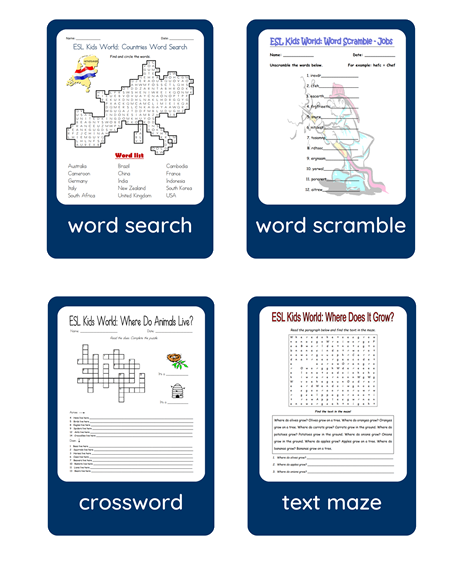
ESL Kids World offers free printable pdf worksheets, board games, gap-fill pages, text-maze puzzles, word scrambles and more.
Classroom Games
Classroom game ideas and activities for learning and practising English. We have practical ideas to make your teaching more fun.
Kids Activities
These include video stories, worksheets, powerpoint, handwriting pages, colouring printables, flashcards, and Jeopardy quizzes for classroom use.
Interactive Quizzes
Our interactive games include, grammar questions, vocabulary quizzes, multiple choice assessments, and fun games to learn English.
Grammar and Vocabulary Exercises

Useful Sites
ESL, TEFL, EFL, ESOL, TESOL Best Sites